Young Adult, Old Dilemma

By Randi Steers
Are teenagers reading? And if they are reading, are they reading enough? It seems like every generation has had this question, or some version of it, hanging over its head; I remember the reading boom in the late nineties and early aughts (my own middle grade and teen years), and the astonishment that came along with it.
Older generations were pleasantly surprised that preteens and teens were reading more than ever before, and made a point to say so; that sentiment was voiced in news segments, talk show interviews, radio monologues, and in classrooms all over the world. It was surprising, apparently, that young people were reading. But what was surprising to me (as a young reader being spoken of at the time), was how novel the concept of, well, novel-reading was for people of my age group.
That was the first time I became aware of The Dilemma: for whatever reason, teenagers are a perpetually elusive group in bookstores and libraries; that's the standard perception, at the very least. Booklovers exists in every age, and across all demographics, so if you're astonished (like I was) by this global, and seemingly timeless, outlook on young readers, you're likely not the kind of person who most needs to ponder The Dilemma.
So, who does? The people and places responsible for books, that's who. It's not the fault of young people that readership has been on the decline in recent years. Worldwide, education has been weakened, libraries defunded, bookstores devalued, that it's hardly any wonder reading in general has suffered. Consequently, literacy rates have started to drop off. And when reading for pleasure gets harder to do, the habit is less likely to stick.
Now, with the global economy what it is, and with spending money scarcer than we'd all like, it can be hard to justify purchasing that third trade paperback, which now costs the same as a special edition hardback from only a few years prior. $100 gets you two new titles nowadays; three if you're lucky. That's nearly prohibitive for families with teens; everything from clothing to electronics can really dent the wallet, and if your kid isn't hounding you for a new book, it can be tempting not to push them to try when the household budget is already spread thin.
And in terms of their own money, be it from a part-time job, or saved up from the bank of mum and dad, teens have even less money to use for their own interests than their adult counterparts, making any moderate purchase feel massive by comparison. Young Adult books are mercifully cheaper, on average, than adult fiction titles (usually 66-75% of the cost), but it's still discouraging to lose all of your holiday money in a single sitting, while only getting a few books out of the deal.
This issue is clearly more complicated than just "teenagers would rather be on their phones than read a book"; technology plays a part, there's no denying it, but there's a nuanced conversation to be had about the factors I've mentioned above, without finger-pointing or laying blame on the victims of these compounding literacy morbidities. Plenty of teens read, but they're often ones who grew up in households where books were ubiquitous. It's not surprising to me that the teens I see come into our store (on their own volition), are usually the ones who've accompanied mum and dad on their own book hunts as regulars.
So, I've explained The Dilemma, laid out the compounding factors contributing to it, and did a little whinging about current affairs. Now what? What's to be done about it? First, set a good example at home. Reading isn't a chore, and it certainly should never be used as a punishment. School reading can already feel like that for a lot of kids, and it doesn't help the case for books when reading is associated with work (homework is work, after all).
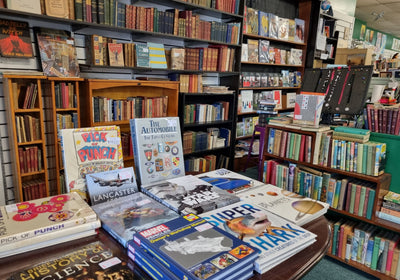
Aside from the things the average person can't control (e.g. the global economy), the easiest way to stretch your book money, is to shop secondhand; most of our books are sold at a fraction (10-50%) of the cost of a new book. Our bookstore has everything from the classics, to the newest titles for every age group, young adult included. In fact, it's one of our biggest sections in the entire shop. We have popular authors, as well as lesser-known gems.
Shopping secondhand doesn't solve every problem levelled at young readers (we're not magic, all appearances aside), but it certainly lowers the barrier of entry, and makes reading far more accessible over the long-term. On the whole, I'd wager that The Dilemma isn't going away; a version of it has been around for as long as reading as a hobby has existed. However, there's always some conversation to be had about how we, as a society, can encourage readership across all ages, and I think secondhand book stores like ours are a great place to start.